
Wednesday June 10, 2026
Huawei Can’t Buy the Machines, So It’s Rewriting the Rules of the Game
For sixty years the computing industry agreed on what “better” meant. Make the transistor smaller, fit more of them in the same space, and the chip got faster, ran cooler, and cost less to build without anyone having to ask. That agreement is quietly dissolving, and the company forcing the issue is the one Washington tried hardest to freeze out.
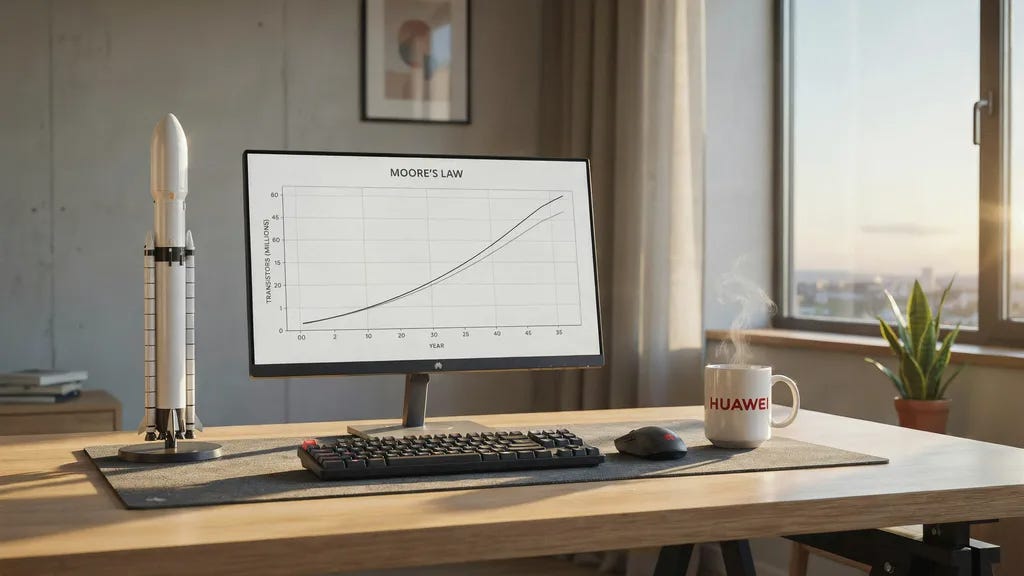
Huawei recently proposed replacing Moore’s Law with something it calls the Tau Scaling Law. It isn’t really discarding Moore so much as swapping the yardstick while keeping the destination. The goal is unchanged, still more density and more performance. What Huawei rejects is the measuring stick. For decades that stick was geometric shrinkage, the size of the transistor itself. Tau Scaling proposes a different one, the signal delay, the few trillionths of a second it takes information to cross the chip. If you cannot shrink the transistor, there is another lever entirely, which is shortening the distance the signal has to travel.
Moore’s Law slowed because physics stopped cooperating. Below seven nanometers, transistors leak current, throw off heat, and cost more per unit to make rather than less. The machines that etch features that small, EUV lithography, are exactly the ones Huawei is banned from buying. So it changed the question instead of fighting for the answer. Its LogicFolding architecture stops spreading circuits across a flat plane and stacks them vertically, floor over floor, like a high rise replacing single story sprawl. Signals that once crawled along long horizontal routes now ride a short elevator between floors.
Here is the part worth trading on rather than admiring. When the scoreboard stops being who owns the smallest transistor, the money stops flowing only to lithography. It migrates toward the layer that makes stacking work, advanced packaging, hybrid bonding, and the brutal job of pulling heat out of a chip that now has stories. Assembly houses like Amkor $AMKR and ASE Technology $ASX matter more in a world that scales by stacking than in one that scaled by shrinking. Watch the thermal problem hardest, because heat trapped between layers is the constraint nobody has cleanly solved, and whoever solves it owns the decade.
Notice the tell that this is positioning as much as physics. Huawei still pegs its 2031 goal to density equivalent to a 1.4 nanometer process, measuring its escape from geometric scaling in the units of geometric scaling. The yardstick changed but the finish line never moved, which is why the thing worth owning is the layer that comes after the transistor, whoever wins the naming fight.

◾ Anthropic releases Fable 5, Mythos-class model, to public (Anthropic)
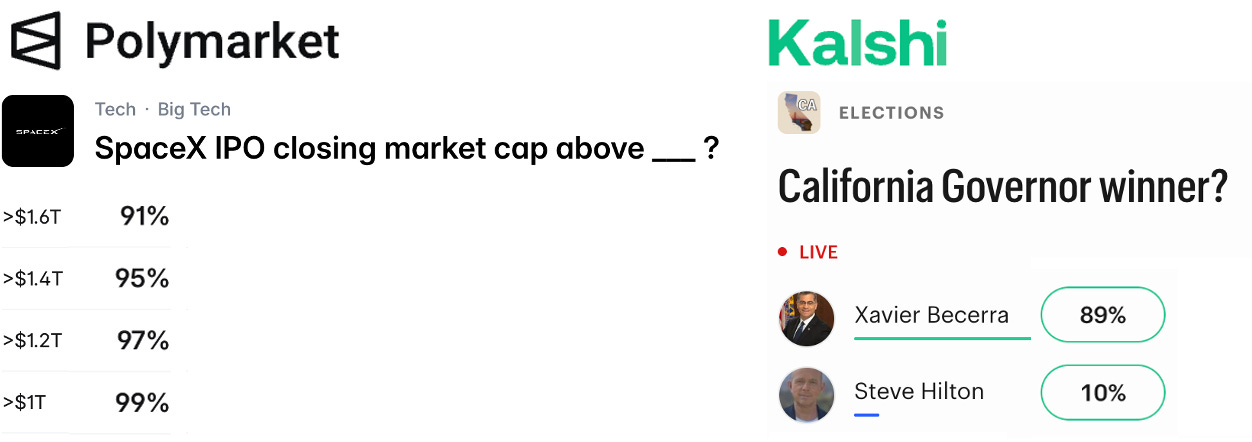
◾ SpaceX IPO demand ~4x oversubscribed (Reuters)
◾ NASA names 3 Americans, 1 Italian as Artemis III lunar crew (NASA)

BitDigest will be taking a short summer break next week and will not be published. I will return the following week with our regular coverage of AI, crypto, gaming, space, and the trends shaping the future.

Government & NGO Actions
◾ EU refuses Apple $AAPL exemption for Siri AI release (Reuters)
◾ EU proposes 21st sanctions package targeting Russian banks, crypto platforms (Reuters)
◾ EU orders Meta $META to allow rival AI chatbots back on WhatsApp (Bloomberg)
◾ Bank of England warns on deepfakes amid Farage-Bailey fight (Guardian)
◾ India Home Affairs ministry withholds Starlink launch approvals (Bloomberg)
◾ Financial Stability Board opens consultation on 12 AI governance practices for financial institutions (FSB)
◾ EIA sees US power consumption rising in 2026, 2027 on data centers, electrification (Reuters)
◾ Rep Lieu D-CA says bipartisan AI framework lacks consensus (Politico)
◾ NY law requiring AI disclosure in advertising takes effect (PIX11)
◾ Another White House AI advisor steps down (Politico)
◾ Sen Warren D-MA questions CFTC ability to police crypto, prediction markets with small staff (Senate Banking)
◾ Seattle enacts year-long ban on new AI data centers (Guardian)
Financial Notices & Public Company Releases
◾ Operation updates:
Cango $CANG May’26: BTC produced 237 | HR 31.6 EH/s | Total BTC held 1,065 (PRNewswire)
BitFuFu $FUFU May’26: BTC produced 177 | BTC sold 134 | HR 19.5 EH/s | Total BTC held 1,855 (GlobeNewswire)
◾ Super Micro Computer $SMCU raising $7B in share offerings for AI expansion (Reuters)
◾ Hut 8 $HUT closes $4.25B senior notes for Beacon Point data center (PR Newswire)
◾ GSR wins FINRA approval to finalize Equilibrium Capital acquisition (Crypto Briefing)
◾ K Wave Media $KWM to retire ~13% of outstanding shares (GlobeNewswire)
◾ Universal Digital $LFGMF to adopt semi-annual financial reporting (Newsfile)
Restructuring, Hacks, Losses & Legal Updates
◾ National Advertising Division to refer Kalshi to regulators over withheld paid-promotion disclosure (GlobeNewswire)
◾ Mississippi residents sue xAI over data center noise (Reuters)
◾ Federal judge disqualifies both attorneys for failing to verify AI-generated research (NYT)
Crypto Protocols, Applications & Business News
◾ Kraken named official crypto exchange of FIFA World Cup 2026 (Kraken)
◾ Brag House $TBH partners with MoonPay to expand global Dogecoin acceptance (GlobeNewswire)
◾ Zodia Custody secures Luxembourg payments license (Zodia)
◾ OKX launches European X-perps for Magnificent 7 (Business Wire)
AI Models, Applications & Developments
◾ SpaceX plans orbital AI computing tests by next year (Reuters)
◾ Meta $META to lease 168 MW India data center from Reliance Industries (CNBC)
◾ Apple $AAPL partners with Google $GOOGL, Nvidia $NVDA on new AI model (CNBC)
◾ ESPN pulls AI images from NBA Finals coverage (Fox News)
◾ SpaceX unveils 11M-square-foot Texas Gigasat factory (Tom’s Hardware)
Space Systems, Satellites & Cosmic Activity
◾ Leonardo SpA expects EU approval for Airbus-Thales satellite venture by end 2027 (Bloomberg)
◾ Finnish satellite operator ICEYE raises €450M at €10B valuation (ICEYE)