
Wednesday April 29, 2026
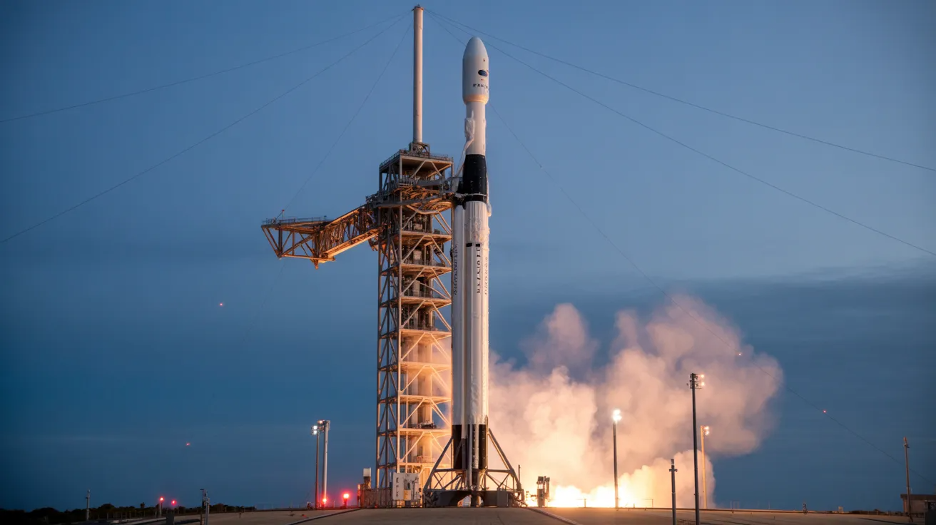
Everyone Is Planning Around SpaceX. That Could Be a Problem.
There is an assumption running through the space industry right now, and it deserves more scrutiny than it is getting.
Dozens of satellite operators, orbital startups, and defense primes are building their launch roadmaps around access to SpaceX launches. The logic makes sense on the surface: Falcon 9 is the most reliable rocket ever flown, transporter rideshare missions are affordable, and Starship is coming. Why structure your business around anything else?
Here is the problem. SpaceX is not standing still while the rest of the industry plans around it. Look at last year’s numbers. SpaceX launched 170 missions in total, five of which were Starship tests. Of the remaining 165 Falcon 9 flights, 123 were Starlink missions serving SpaceX’s own constellation. Roughly 15 went to US government customers including NASA, the Space Force, and the NRO. That left approximately 30 launches for the entire commercial market. Thirty out of 170.
And that number is not going to grow faster than SpaceX’s own internal demand. Starship requires enormous launch cadence just to prove itself out. Gen 2 Starlink satellites are heavier, meaning they will dominate Starship’s early manifest as SpaceX transitions the constellation to its new rocket. National security contracts are expanding, with the Pentagon awarding SpaceX a $5.9 billion NSSL Phase 3 contract covering missions through the end of the decade. Polaris and other crewed programs take priority over third-party rideshare. SpaceX has always been clear about where its interests sit, and that is not a criticism. It is actually part of why the company is so successful. This matters enormously if your business depends on getting a slot.
Launch access is quietly shifting from a commodity assumption to a strategic constraint, and most of the space economy has not caught up to that reality. Founders and investors are still pricing rideshare like bandwidth in 2010: cheap, getting cheaper, and essentially unlimited. The data says something different. Dedicated Falcon 9 launches now run $74 million, up roughly 20% over three years, and rideshare rates have hit $7,000 per kilogram with SpaceX adding approximately $500 per kilogram annually on a structured schedule.
Companies that built their business models around cheap, plentiful SpaceX capacity face a compounding problem: costs are rising while available slots are shrinking. They could also find themselves paying more to wait longer behind customers SpaceX cares more about. That risk is real, and most cap tables are not pricing it in.

◾ SpaceX ties Musk compensation to Mars colonization and outer space data center milestones (Reuters)
◾ Amazon $AMZN launches AI co-worker desktop assistant (About Amazon)
◾ White House developing plan to re-onboard Anthropic across agencies (Axios)


Government & NGO Actions
◾ EU finds $META failed to prevent minors from accessing Facebook and Instagram (CNBC)
◾ EU Parliament fails to reach deal on AI regulatory framework (Reuters)
◾ California coastal regulator apologizes to SpaceX, settles over launch restriction bias (Reuters)
◾ Canada to propose ban on crypto ATMs (Canada Budget)
◾ Czech Central Bank recommends adding bitcoin to model portfolio (Bloomberg)
◾ Florida House sidelines Governor’s AI bill (Miami Herald)
◾ DHS meets with OpenAI and Anthropic over AI model security concerns (Axios)
◾ CFTC sues Wisconsin to affirm jurisdiction over prediction markets (CFTC)
◾ Israel approves first shekel-backed stablecoin (LinkedIn)
◾ FTC settles with former Celsius CEO Alex Mashinsky for $10M and lifetime investment ban (Cryptonomist)
◾ CFTC developing AI tools to monitor trading and review crypto registration applications (CoinDesk)
◾ Japan FSA urges real estate firms to strengthen AML checks on crypto property transactions (FSA)
Financial Notices & Public Company Releases
◾ Financial updates:
Visa $V Q2’26: Revenue $11.2B +17% y-y | NI $6B +32% y-y | Payments volume + 9% | Processed transactions +12% (Visa)
Galaxy Digital $GLXY Q1’26: Revenue $10.2B | Net loss $216M | aEBITDA loss $187M (Galaxy)
Robinhood $HOOD Q1’26: Revenue $1.0B +7% y-y | NI $346M +3% y-y | aEBIDTA $534M +14% y-y | ARPU $157 +8% y-y (Robinhood)
◾ Operation updates:
Hyperscale Data $GPUS Total BTC holdings $53.1M (PR Newswire)
Restructuring, Hacks, Losses & Legal Updates
◾ Judge rejects Sam Bankman-Fried motion for new trial (Bloomberg)
◾ Musk testifies at OpenAI trial: “not OK to steal a charity” (WSJ)
◾ Polymarket denies 300K-record data breach claims (Crypto Times)
◾ US soldier accused of betting on Maduro removal pleads not guilty (BBC)
Crypto Protocols, Applications & Business News
◾ Paul Tudor Jones says bitcoin remains best hedge against inflation (X)
◾ State Street $STT to launch tokenized fund servicing out of Luxembourg (Business Wire)
◾ Bybit partners with Money Badger to expand crypto QR payments across South Africa (PR Newswire)
◾ Standard Chartered and BlackRock launch framework allowing clients to use $BUIDL as collateral on OKX (Reuters)
◾ Tether orders hash board modules from Canaan $CAN for mining and compute systems (PR Newswire)
AI Models, Applications & Developments
◾ Apple $AAPL to overhaul photo editing with AI in iOS 27 (Bloomberg)
◾ Nvidia $NVDA exec: cost of compute today exceeds cost of human workers (Fortune)
◾ Nvidia $NVDA launches Nemotron agentic AI model for multimodal tasks (NVIDIA Blog)
◾ OpenAI expands partnership with Amazon $AMZN AWS via Bedrock (About Amazon)
The Attention Economy, Gaming & Interactive Shifts
◾ Polymarket seeks CFTC approval to repatriate main exchange to US (Bloomberg)
Space Systems, Satellites & Cosmic Activity
◾ SpaceX plans to expand operations to Baltimore area (Biz Journals)