
Tuesday June 9, 2026
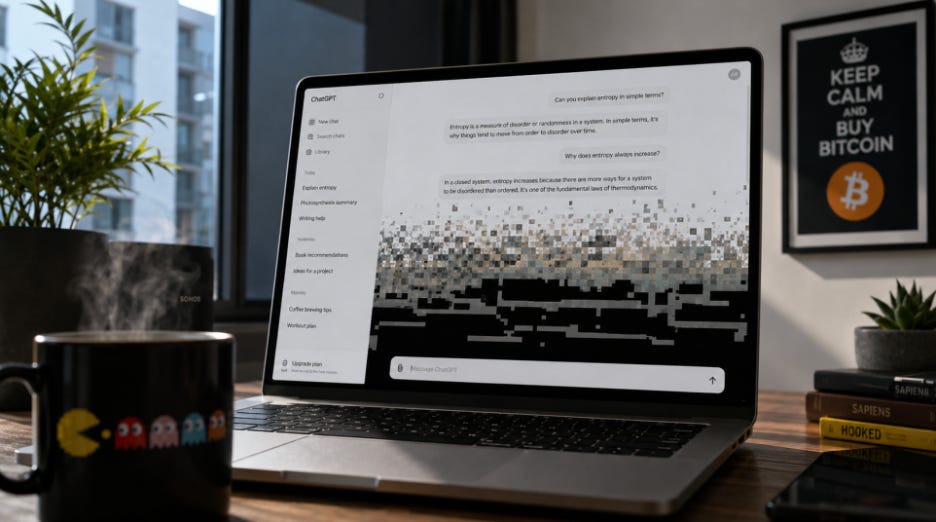
AI is Killing Your Laptop
We were told the AI revolution would live in the cloud. Someone else’s servers, someone else’s electricity, someone else’s problem. You just open a tab and the intelligence arrives. That story is mostly true, and it is also quietly wrong in a way that is about to land on millions of laptops at once.
Here is what I noticed on my own machine. The browser, not the model, is the thing that breaks first. A single long AI conversation can hold over a gigabyte of memory hostage, because your browser keeps every message, every code block, every generated image rendered and waiting in case you scroll back up. The model remembers nothing on your hard drive, but your browser remembers everything for the length of the session. Every time you reopen that project or that chat, the browser pulls the whole conversation back down and rebuilds it in active memory from scratch. You are not storing one heavy copy, you are recreating it again and again, every tab and every morning, and the bigger your history grows the heavier each rebuild becomes. Now run all of this inside one of the new AI native browsers, where an assistant sits on every page and an agent works in the background even when you are not asking it to, and you are paying a tax you never agreed to.
The memory pressure is only the part you can see. Underneath it sits a second cost that shows up as heat and time. All that rendering, all that constant rebuilding, and all those background agent processes burn CPU and GPU cycles, and cycles are just electricity with a temperature. The fans spin up, the battery that used to last all afternoon now begs for a charger by lunch, and the chip runs hot enough that sustained use quietly shortens the life of the hardware. None of this appears on a bill. It appears as a machine that feels older than it is.
Then there is Apple, pulling in the opposite direction and arriving at the same destination. Apple wants the intelligence to live on your device rather than in the cloud, which sounds like the privacy friendly answer. But on-device AI has to eat on-device resources. Apple Intelligence already demands a minimum of 8GB of RAM and 7GB of storage, up from 4GB when it launched, and Apple states plainly in its own footnotes that the requirement will keep climbing as features roll out. That is why some perfectly good phones were locked out on day one, and why the newest hardware quietly carries more memory than any human typing a text message could ever need. The AI did not ask your permission to move in, it simply needed a bigger room.
The throughline for the average user is that an AI habit slowly degrades a machine that used to feel fine, and most people will blame the laptop rather than the tool.
The investable observation is simple. The next bottleneck in consumer AI is not intelligence, it is the device in your hands. Watch who solves memory and power at the edge, because that is where the next quiet fortune gets made.

◾ OpenAI files confidential S-1 to go public (OpenAI)
◾ Elon Musk releases primer video on orbital data centers (SpaceX)
◾ Apple $AAPL unveils new Siri AI (Apple)


Government & NGO Actions
◾ China readies $295B plan to fund nationwide AI buildout (Bloomberg)
◾ UK proposes letting investment funds hold under 10% allocation in crypto ETNs (FCA)
◾ Pentagon adds Alibaba $BABA and Baidu $BIDU to Chinese military-linked firms list (CNBC)
◾ FCC waives Amazon $AMZN requirement to launch half its LEO broadband constellation by July 30 (Ars Technica)
◾ NASA to relocate headquarters by year end (Universe Magazine)
◾ France fines Nintendo $NTDOY €35M over Switch Joy-Con controller defect (Le Monde)
◾ Chinese court rules bitcoin is property in theft case (Cointelegraph)
◾ South Korean police raid Bithumb (News1)
Financial Notices & Public Company Releases
◾ Financial updates:
eToro $ETOR May’26: AUA $20.1B +18% y-y | Funded accounts $4.23M + 17% y-y | Crypto trades 2.2M – 31% y-y (GlobeNewswire)
◾ Operation updates:
Strategy $MSTR + 1,550 BTC | Total BTC holdings 845k (Strategy)
Bitmine Immersion $BMNR +126k ETH | Total BTC holdings 5.5M (PR Newswire)
Strive $ASST +32 BTC | Total BTC holdings 19,032 (Strive)
Hyperscale Data $GPUS BTC holding 709 (PR Newswire)
◾ Quantum Space to go public via $1.2B SPAC (Reuters)
◾ Bending Spoons files to go public (The Information)
◾ BlackRock $BLK launching European space ETF that adds new listings, iShares Space Technologies UCITS ETF $STAR (Bloomberg)
◾ Hyperscale Data $GPUS to buy back $5M in tender offering (PR Newswire)
◾ Perplexity planning 2028 IPO (CNBC)
◾ Genius Group $GNS approves 13.2M share buyback (GlobeNewswire)
◾ SOL Strategies $STKE sells 65k SOL to pay down C$5.75M debt (Newsfile)
Restructuring, Hacks, Losses & Legal Updates
◾ Sam Bankman-Fried files for presidential pardon (Bloomberg)
Crypto Protocols, Applications & Business News
◾ MetaMask introduces agent wallet (MetaMask)
◾ Japan’s SBI Shinsei Bank to reward depositors with crypto vouchers worth ~20% of cash interest (Nikkei)
◾ 200+ crypto organizations sign letter backing Clarity Act (Stand With Crypto)
AI Models, Applications & Developments
◾ OpenAI raises $122B at $852B valuation (OpenAI)
◾ Goldman $GS and JPMorgan $JPM explore trading compute futures (The Information)
◾ $GOOGL and Nvidia $NVDA weigh Intel $INTC as backup chip supplier (The Information)
◾ Apple $AAPL delays European Siri AI rollout over lack of regulatory discussion (Apple)
◾ Nvidia $NVDA and Hyundai deepen physical AI and robotics partnership (Bloomberg)
Space Systems, Satellites & Cosmic Activity
◾ OQ Technology plans direct-to-smartphone demo using cellular spectrum (SpaceNews)